April–June
Favorable weather for hiking and clear visibility.
Experience China's most dramatic cable car ascent, walk cliffside glass paths, and stand beneath a towering natural arch carved through rock.
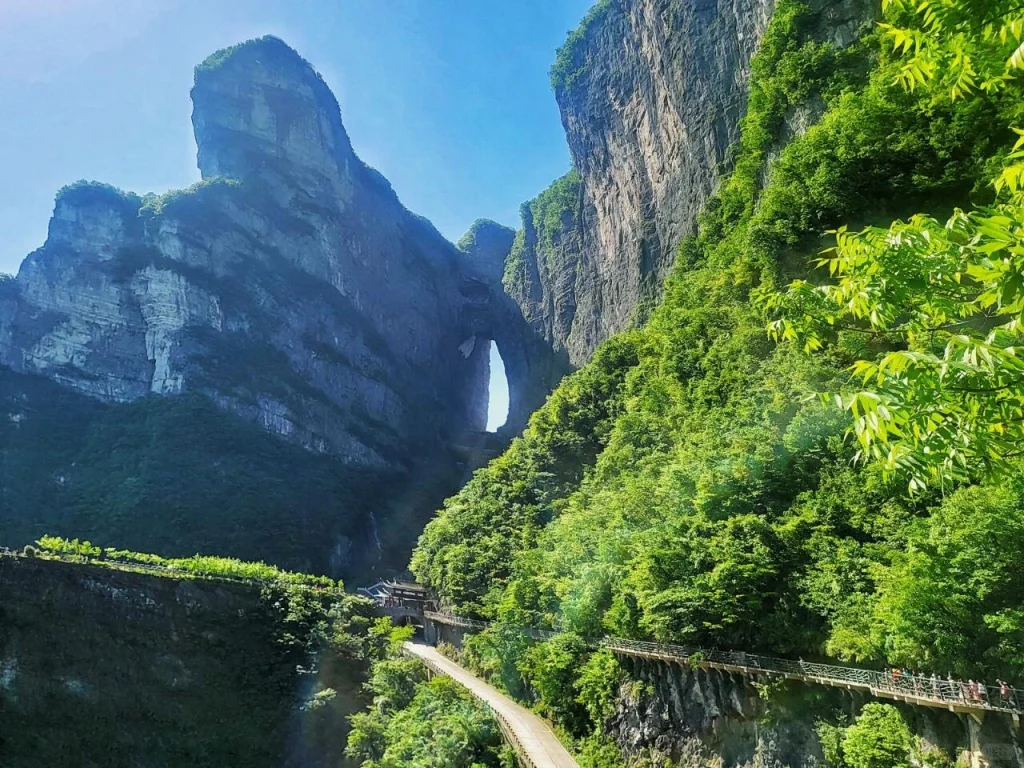
Explore AttractionsHeaven's Gate opened naturally 1,300 years ago when a section of Tianmen Mountain's western face collapsed, leaving a freestanding archway large enough to frame the sky.
The event triggered folklore about celestial intervention, and the mountain became a pilgrimage site centuries before cable cars or glass platforms existed. Today the archway remains the site's gravitational center, but the infrastructure built around it has rewritten the terms of access.
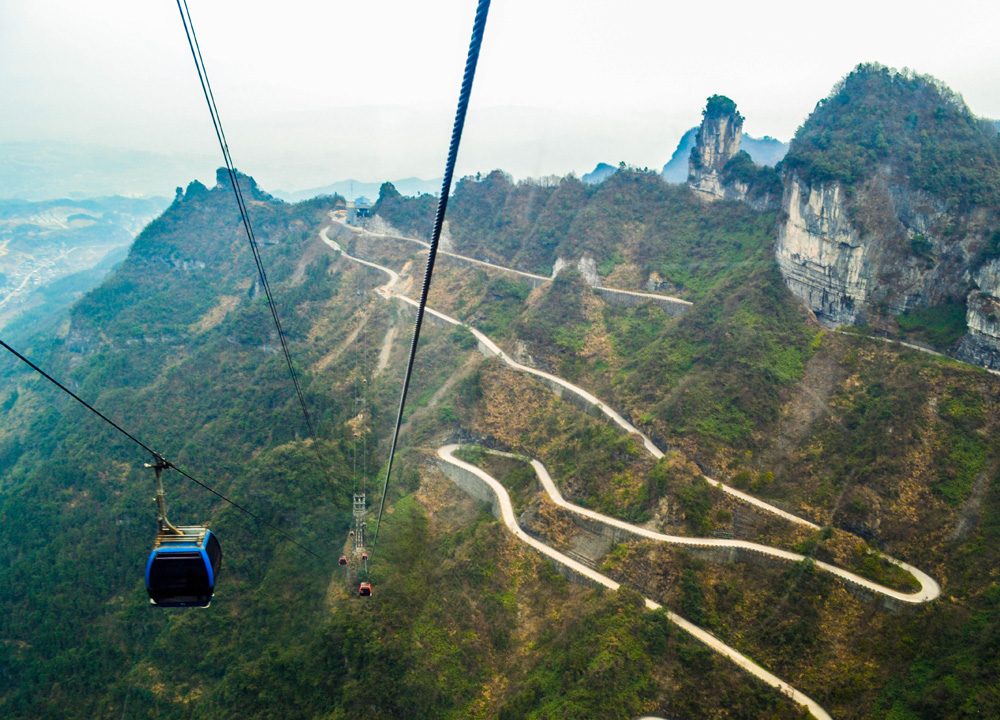
The Tianmen Mountain cable car departs from Zhangjiajie's urban core and climbs through residential neighborhoods before entering open air above terraced fields and forested slopes. The ascent reveals the mountain's structure—stratified limestone tilted at severe angles, cliffs interrupted by narrow ledges where pines root in crevices. At the summit, two zones compete for attention: the eastern cliff walk system, where glass skywalks and the Coiled Dragon Cliff plank path follow rock walls, and the western approach to Heaven's Gate itself, reached via road or by descending 999 steps carved into the mountainside. Tianmen Mountain private tours provide guided context for the geology and cultural layers, while Tianmen Mountain and Zhangjiajie National Forest Park combo itineraries connect the site to the sandstone pillars that inspired Avatar's floating peaks.
The mountain's notoriety grew through calculated spectacle—wing-suit flyers threading the archway, sports cars navigating the switchback road, tightrope walkers crossing the gap. These events positioned Tianmen Mountain as a stage for engineered daring, and the glass skywalk tours continue that narrative by making exposure recreational. Booking Tianmen Mountain cable car tickets in advance avoids multi-hour queues during April through October, when visibility and temperature align with peak visitation. The site appeals to those who measure travel by adrenaline and altitude, and who accept that the natural formation now shares equal billing with the infrastructure that delivers crowds to its base.
Visitors seeking solitude will find little on Tianmen Mountain—the cable car moves 3,000 passengers per hour, and the glass platforms draw selfie queues—but those who value engineered access to otherwise unreachable topography will find the investment justified. The mountain offers verticality without technical climbing, and views that compress distance into layered abstraction when clouds cooperate.
“Heaven's Gate opened naturally 1,300 years ago when a section of Tianmen Mountain's western face collapsed, leaving a freestanding archway large enough to frame the sky.”
A 131-meter natural opening carved through vertical rock, reached by 999 stone steps from the mountain road below.
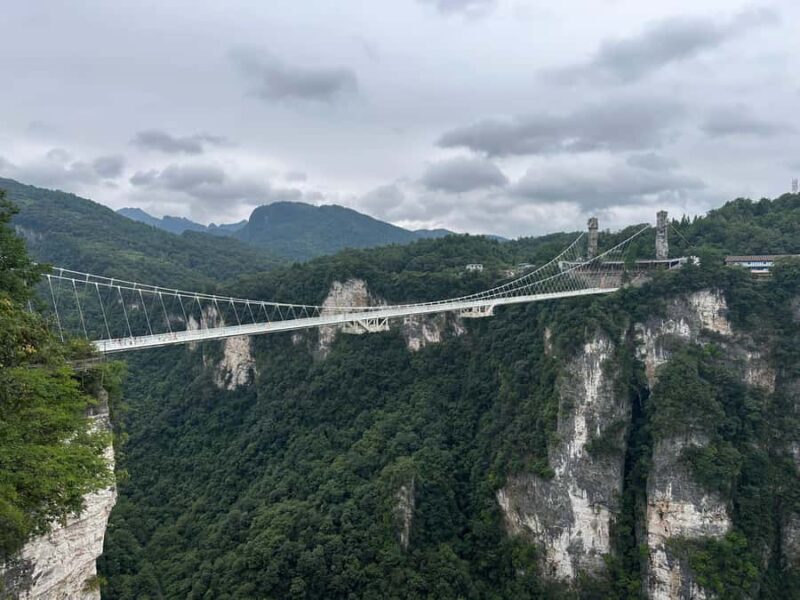
Transparent walkways bolted to cliff faces offer unobstructed views 1,400 meters above the valley floor.
The world's longest passenger ropeway climbs from city level to summit in a 30-minute journey through mist and peaks.
Tianmen Mountain offers a carefully curated set of experiences that balance natural drama with accessibility. Whether you're drawn to the engineering feat of the cable car, the thrill of walking on glass suspended above the void, or the convenience of guided exploration, each option addresses a different visitor priority. Private tours deliver flexibility and local insight, combo packages pair the mountain with nearby Zhangjiajie National Forest Park, and standalone tickets let you tackle the cable car or skywalk independently.
Viewpoint
Guided sessions on the 60-meter transparent walkway cantilevered over a 1,430-meter drop, with safety briefings and shoe covers included.
Transport
Pre-booked access to the 7.5 km ride that climbs 1,279 vertical meters, bypassing ticket queues and securing departure slots during peak periods.
Tour
Multi-day packages linking the vertical drama of Tianmen Cave with the sandstone pillars that inspired Avatar's floating mountains.
Tour
Tailored itineraries with dedicated guides who navigate crowds, arrange transport, and share geological and cultural context you'd miss on your own.
Tianmen Mountain requires a full day to experience properly, with the cable car ascent, summit trail loop, and descent through Tianmen Cave forming the core circuit. A two-day itinerary allows you to explore the mountain at a relaxed pace, add nearby Zhangjiajie National Forest Park, and revisit favorite sections without rushing.
Board the 7.5 km cable car from the city station for a 30-minute ride over karst valleys and up the cliff face. Arrive at the upper station and begin the summit trail loop, heading west toward the Skywalk.
View guideWalk the transparent cliff-edge platform cantilevered 60 meters above the void. The loop continues past Yunmeng Fairy Summit, the mountain's highest accessible point at 1,518 meters.
View guideComplete the summit loop via the eastern section, passing Tianmen Temple and forested pathways. Lunch options are available near the temple plaza.
Descend the stone staircase to Tianmen Cave, the natural arch that pierces the cliff. The steps are steep; allow 40 minutes down, longer going up.
Board the mountain shuttle bus from Tianmen Cave back to the city center. The winding road features 99 bends and takes 30 minutes.
Depart early for the UNESCO site 40 km south, home to the quartzite pillars that inspired Avatar's floating mountains. Explore Yuanjiajie and Golden Whip Stream.
View guideChoose between a boat tour on Baofeng Lake's jade-green water or continue hiking Tianzi Mountain's ridgeline trails. Both are included in multi-day combo packages.
View guideReturn to Zhangjiajie city with a private guide who can adjust timing and provide transport between sites. Dinner in the Dayong Road food district.
View guideTianmen Mountain is accessible via a centralized transport system located in Zhangjiajie city center. Visitors use a mix of cable cars and dedicated shuttle buses to navigate the mountain's steep terrain.
Zhangjiajie Public Transport operates routes throughout the city. Use the official site or local maps to identify lines reaching the lower cable car station, with a single ride costing ¥2.00.
Taxis are available throughout the city and use meters to calculate fares. The rate is ¥2.00 per km.
The Tianmen Mountain cable car departs from the city station, while internal shuttle buses transport visitors between the mountain summit and the Tianmen Cave entrance.
From the airport: Travelers arriving at DYG Zhangjiajie Hehua International Airport can reach the city center via taxi in 15 min for ¥20–30.
The peak season spans April–October, offering the most reliable access to the mountain's high-altitude paths. Shoulder seasons provide a balance between moderate temperatures and smaller crowds compared to the summer months.
Favorable weather for hiking and clear visibility.
Peak season demand requires advance planning for queues.
Considered the most stable period for visibility.
Winter conditions may lead to partial site closures.
Frame the massive natural arch from the stairs looking upward to capture the scale of the opening.
Photograph the winding turns of the mountain road from the cable car for a geometric perspective.
Position the camera along the narrow cliffside path to capture the sheer vertical drop against the mountain face.
Focus on the traditional architecture set against the backdrop of the surrounding forested peaks.
Tianmen Mountain rises 1,518 meters above Zhangjiajie, anchoring centuries of Taoist mythology and local folklore. The Heaven's Gate cave—a 131-meter-high natural arch piercing the cliff face—first appeared in 263 CE when a section of the mountain collapsed, creating what locals interpreted as a divine portal. Taoist hermits established shrines on the summit during the Tang Dynasty (618–907 CE), drawn by the mountain's perceived spiritual power and its position above the clouds. The 999-step stairway to Heaven's Gate was constructed during the Ming Dynasty in the early 1400s, cementing the site's role as a pilgrimage destination for devotees seeking enlightenment. The modern transformation began in 1997 when French pilot Bruno Rodini flew through the natural arch, capturing global attention. Zhangjiajie authorities opened Tianmen Mountain tours to the public in 1999, installing the world's longest cable car—7,455 meters spanning from the city center to the summit. The Tongtian Avenue, a winding road with 99 hairpin bends carved into the cliff between 1998 and 2005, became an engineering landmark. The glass skywalk, cantilevered 60 meters from the cliff edge, opened in 2011, attracting visitors seeking both cultural heritage and modern thrills. Today the Taoist temple complex on the summit remains active, with monks maintaining daily rituals amid the flood of tourists. Visitors purchasing Tianmen Mountain tickets encounter incense smoke drifting from centuries-old shrines, while the Heaven's Gate arch—visible from the base—still commands reverence as the mountain's defining natural and spiritual monument.
Heaven's Gate natural arch forms when a section of the mountain collapses, interpreted by locals as a divine portal.
Taoist hermits establish summit shrines during the Tang Dynasty, drawn by the mountain's spiritual significance.
Ming Dynasty engineers construct the 999-step stairway to Heaven's Gate, formalizing the pilgrimage route.
French pilot Bruno Rodini flies through the natural arch, bringing international attention to the site.
Zhangjiajie opens Tianmen Mountain tour operations and completes the 7,455-meter cable car, the world's longest at the time.
Workers carve Tongtian Avenue into the cliff face, creating a road with 99 hairpin bends.
The glass skywalk opens, cantilevered 60 meters from the cliff edge at 1,430 meters elevation.
Tianmen Mountain offers breathtaking natural wonders including the famous Heaven's Gate cave, thrilling glass skywalks clinging to cliffs, the world's longest passenger cable car, and the winding 99-Bend Road.
Visitors typically choose between Line A (Cable car up, bus down) and Line B (Bus up, cable car down). Both routes allow you to see the main attractions like the Skywalks and Heaven's Gate, just in a different order.
The best time to visit is from April to October when the weather is mild. Clear days offer the best expansive views, while misty days provide a mystical atmosphere. It is best to avoid Chinese public holidays.
Yes, booking tickets in advance is essential. Daily visitor numbers are capped, and tickets for specific time slots often sell out days ahead, especially during peak travel seasons.
While the cable car makes the ascent easy, the summit involves significant walking. The 999 steps to Heaven's Gate are steep, but a tunnel escalator is available for those who cannot climb them.
The Tianmen Mountain Cable Car station is conveniently located in downtown Zhangjiajie, near the train station. If taking the bus route, shuttles depart from the mountain base which is accessible via the city center.
The standard admission ticket is a combination pass that includes the round-trip transportation (cable car and bus) and park entry. Small extra fees apply on-site for glass skywalk shoe covers or specific chairlifts.
To beat the crowds, book the earliest possible time slot for the cable car (Line A). Visiting on weekdays and avoiding the peak summer months of July and August will also result in fewer visitors.
Choose from amazing attractions and create unforgettable memories in this beautiful city
Book Your Experience Now